All Categories
Featured
Table of Contents
Want to find out more about O1, EB1A and EB5? Set up a complimentary assessment- Join our neighborhood to get very first access to functions and referrals - - Follow to remain upgraded on high-skilled migration, tasks, and tech.
Develop a scalable AI technique based upon insights from effective IT leaders and organization choice makers. In, you'll learn best practices across five chauffeurs of success including: Make certain AI jobs line up to service objectives. Lay the structure for reputable, scalable solutions. Build repeatable processes that deliver concrete business value.
Deploy AI that fulfills security, privacy, and regulatory requirements.
In 2026, companies will not ask whether they must embrace AI, however rather how efficiently and properly they can embed it into every layer of their company. The idea of enterprise AI adoption is no longer restricted to automating a couple of procedures; it represents a basic shift in how business think, choose, operate, and grow.
Why AI-Cloud Convergence Is Vital for Modern Business
It also discusses a complete AI execution strategy, presents a scalable AI adoption structure, and lays out proven business AI best practices that companies need to follow to prosper in the next generation of digital company. An AI roadmap 2026 is a structured and positive plan that specifies how an organization will adopt, scale, and govern artificial intelligence over the next few years.
The value of an AI roadmap lies in its ability to bring clarity and positioning. Without a roadmap, business frequently purchase numerous detached AI tools that stop working to provide measurable organization worth. A roadmap, on the other hand, assists leaders determine concerns, allocate resources efficiently, handle threats, and measure development gradually.
A well-defined AI adoption structure offers a structured design for assisting business through the complex journey of AI transformation. This framework ensures that AI adoption is systematic, scalable, and sustainable rather than fragmented and reactive. The most efficient AI adoption structure for 2026 consists of six interconnected phases: strategic alignment, information readiness, use case design, AI advancement, governance, and scaling.
Enterprises constantly fine-tune their AI method based on new data, developing organization objectives, regulatory modifications, and technological advancements. The very first and most vital action in business AI adoption is establishing a clear tactical vision.

In this phase, organization leaders should determine how AI supports their long-term goals, whether it is improving consumer fulfillment, increasing income, decreasing operational expenses, or boosting risk management. AI initiatives need to be aligned with corporate method, industry positioning, and competitive distinction.
Key Frameworks for Updating Your Digital Enterprise
Information is the lifeblood of AI. Without top quality, available, and well-governed data, even the most advanced AI systems will fail. This makes information readiness a foundation of any AI execution technique. Enterprises must examine the maturity of their data ecosystem, consisting of information sources, information quality, storage systems, and governance practices.
Enterprises needs to invest in central information platforms, cloud or hybrid infrastructures, real-time information pipelines, and strong data governance structures. Data privacy, security, and compliance with policies such as GDPR and emerging AI laws need to likewise be integrated into the information strategy. This phase guarantees that AI systems are constructed on trusted, ethical, and scalable information structures.
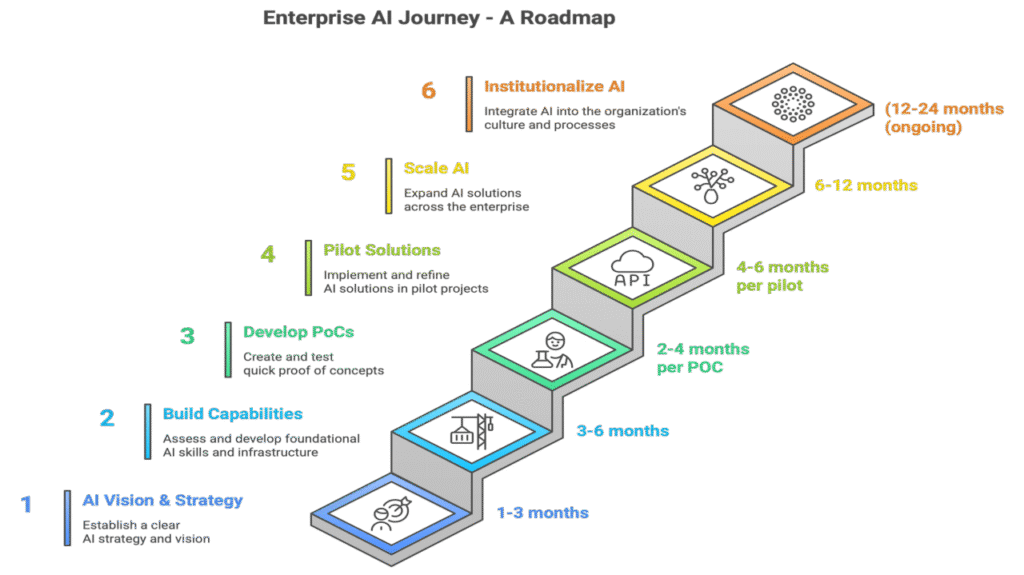
Not every process must be automated, and not every issue needs AI. Smart enterprise AI adoption focuses on use cases that deliver quantifiable company effect.
Building Robust Cloud-Native Systems
Each use case must be evaluated based on organization value, technical feasibility, information schedule, and danger. Enterprises ought to begin with workable projects that show fast wins, construct internal confidence, and create momentum for larger initiatives. This stage includes structure, training, and releasing AI designs into genuine organization environments. It consists of choosing proper artificial intelligence strategies, training models on business data, screening performance, and incorporating AI systems with existing applications.
Magnate should comprehend how AI comes to choices to ensure trust and accountability. Implementation ought to be supported by MLOps practices, which automate model tracking, retraining, variation control, and efficiency optimization. This guarantees that AI systems stay accurate, appropriate, and secure in time. As AI becomes more effective, governance ends up being more vital.
An enterprise-level AI governance framework includes clear accountability structures, ethical guidelines, risk evaluation procedures, and human oversight systems. This ensures that AI systems align with organizational values, legal standards, and social expectations.

Latest Posts
Cloud-Native and Legacy Architectures Compared
Why Intelligent Cloud Convergence Matters in 2026
Mastering the Intersection of AI and Digital Platforms